
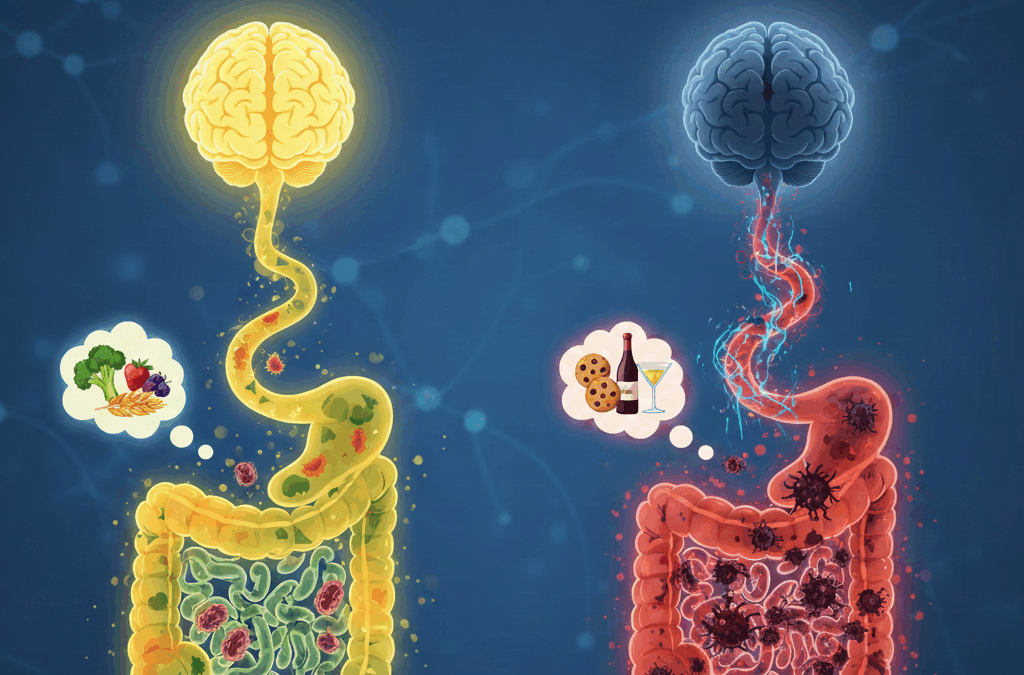
This article includes information generated with the assistance of ChatGPT (OpenAI, 2025). The content was reviewed and edited for accuracy by the author, Michelle Jenck, M.Ed. Health & Kinesiology and peer-reviewed by Lewis Martin, Registered Dietician.
If you’ve ever wondered why cookies or wine feel almost magnetic during stress or fatigue, the answer may be inside you—literally.
Your digestive system is home to trillions of tiny organisms such as bacteria and yeast. Together, they form what scientists call the gut microbiome. In the past few years, researchers have discovered that this community plays a powerful role in digestion, metabolism, immune health—and even cravings.
This means cravings are not just willpower problems—they’re biological.
Your Gut and Brain Are Constantly Talking
The gut has its own nervous system called the enteric nervous system, sometimes referred to as the “second brain.” It communicates with the brain through something called the gut–brain axis.
Surprisingly, about 95% of your body’s serotonin—a chemical that affects mood, sleep, and appetite—is made in the digestive tract, not the brain (Gershon, 2013).
When the gut is healthy and diverse, appetite and mood are more stable. But when the microbiome becomes unbalanced—often from stress, a low-fiber diet, disrupted sleep, antibiotics, or high intake of sugar or alcohol—the brain receives different chemical signals.
Those signals can increase cravings—especially for sweet foods and alcohol (Mayer et al., 2015).
Why Cravings Increase When the Gut Is Out of Balance
- Some microbes “feed” on sugar and alcohol.
When you consume sugary foods or alcohol, the microbes that thrive on those fuels grow stronger—and they send messages encouraging you to eat more (Alcock, Maley, & Aktipis, 2014). - Sugar and alcohol spike blood sugar levels, then cause a crash.
Your brain interprets that crash as an emergency and pushes you to grab quick energy (Lustig, Schmidt, & Brindis, 2012). - Alcohol disrupts gut balance.
Research shows alcohol reduces beneficial bacteria, increases gut permeability (“leaky gut”), and triggers inflammation—not only in the gut but in brain pathways linked to reward and impulse control (Engen et al., 2015). - Stress reshapes the gut.
Chronic stress raises cortisol, lowers helpful bacteria, and increases emotional cravings—especially for sweets and alcohol (Farzi, Fröhlich, & Holzer, 2018).
The Good News: A Healthy Gut = Fewer Cravings
People who improve gut health often report:
- fewer afternoon sugar urges
- less desire for alcohol
- better mood and sleep
- more steady energy
- less bloating
Research shows that diets high in fiber, fermented foods, and plant compounds support healthy cravings and a more balanced appetite (Sonnenburg et al., 2021).
Cravings aren’t personal weakness—they’re messages from your biology.
By nurturing your gut, you can steady your appetite, support emotional balance, and shift your cravings naturally.
Key References
- Alcock, J., Maley, C., & Aktipis, C. (2014). Is eating behavior manipulated by the gastrointestinal microbiota? BioEssays, 36(10), 940–949.
- Engen, P. A., Green, S. J., Voigt, R. M., Forsyth, C. B., & Keshavarzian, A. (2015). The gastrointestinal microbiome: Alcohol effects on the composition. Alcohol Research: Current Reviews, 37(2), 223–236.
- Farzi, A., Fröhlich, E. E., & Holzer, P. (2018). Gut microbiota and the neuroendocrine system. Neurotherapeutics, 15, 5–22.
- Gershon, M. (2013). The Second Brain. HarperCollins.
- Lustig, R. H., Schmidt, L., & Brindis, C. D. (2012). Public health: The toxic truth about sugar. Nature, 482, 27–29.
- Mayer, E. A., Knight, R., Mazmanian, S. K., Cryan, J. F., & Tillisch, K. (2015). Gut microbes and the brain. Journal of Neuroscience, 35(46), 13871–13879.
- Sonnenburg, E. D., et al. (2021). Gut-microbiota-targeted diets modulate human immune status. Cell, 184(16), 4137–4153.