
By Michelle Jenck, M.Ed Health & Kinesiology
Have you ever noticed how stress shows up in your body? Tight shoulders, shallow breath, a racing heart? Our bodies often carry the stories of stress and trauma long after the moment has passed. That’s where somatic therapy—healing through mindful movement—comes in.
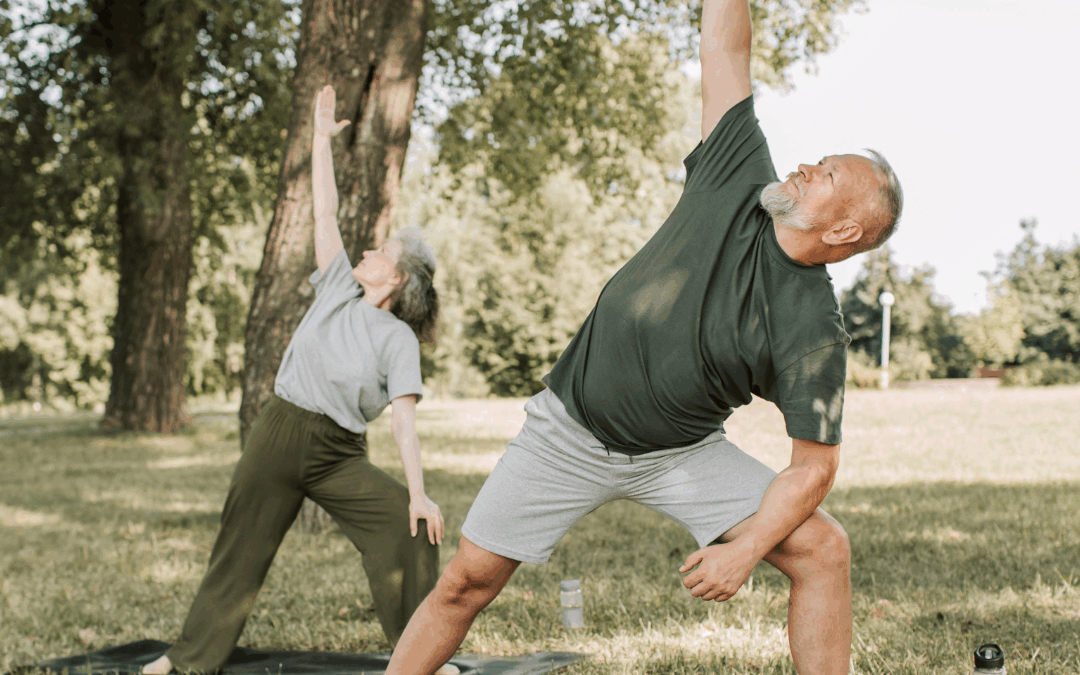
The word somatic means “of the body.” This type of therapy recognizes that healing isn’t just about what we think or talk about—it’s also about how we feel and move. Gentle practices like yoga, breathwork, or guided body awareness can help calm the nervous system, release tension, and restore a sense of safety and connection. Recent research is shining light on just how powerful these practices can be, especially for people living with trauma, depression 1 or chronic pain.
Trauma Recovery Through the Body
When we experience stress or trauma, our bodies don’t just “get over it” once the event is past. Muscles can stay tense, breathing can remain shallow, and the nervous system can get stuck in “fight-or-flight” mode. Somatic therapies aim to help people reconnect with their physical sensations, calm the nervous system, and restore a sense of safety in the body.
In the book, The Body Keeps the Score, author and psychiatrist, Bessel van der Kolk states, “If the memory of trauma is encoded in the viscera, in heartbreaking and gut-wrenching emotions, in autoimmune disorders and skeletal/muscular problems, then it stands to reason that the cure must involve the body.” What’s clear is that many trauma survivors find body-based practices to be a gentle, empowering complement to traditional talk therapy. Trauma-sensitive yoga, for example, has been shown in clinical trials to reduce PTSD symptoms 2 and improve emotional balance.
Finding Relief from Chronic Pain
Somatic therapy isn’t just for trauma—it’s also helping people with chronic pain. A large 2025 study 3 found that mindfulness-based movement and body awareness practices worked just as well as cognitive behavioral therapy (CBT) for people with long-term back pain. Even better, the benefits lasted for a year after the program ended.
Other forms of body-awareness training, such as learning to tune into inner signals like heartbeat, tension, or hunger cues, are showing early promise for reducing stress, improving emotional regulation, and even supporting recovery from addiction.
What to Expect
Somatic programs can be on-going (like a yoga class) or may run for 8–12 weeks. Classes are usually gentle, adaptable for different ages and fitness levels, and focused more on awareness than performance. Most classes are offered at least weekly, and more commonly 2-3 times/week. As with any movement regimen, frequency and consistency are key to creating lasting results. There are many local yoga classes offered through the Kiawanda Community Center, Tillamook YMCA and NCRD in Nehalem, including a Yoga for Veterans class.
Getting Started
If you have serious concerns or aren’t sure what the right options are for you, be sure to seek guidance from a mental health professional. If you’re curious about trying somatic therapy as a stand-alone or complementary mental health therapy, here are a few options that may be offered through community centers or online:
- Trauma-sensitive yoga classes
- Mindfulness-based stress reduction (MBSR) or other guided meditation programs with a body-awareness focus
- Simple daily practices like stretching, deep breathing, or body scans you can do at home
The science is still evolving, but the message is clear: movement isn’t just exercise. It’s medicine for the mind and body—helping us feel more grounded, more present, and more whole.
Resources:
- Noetel, M., et al. (2024). Effect of exercise for depression: systematic review and network meta-analysis of randomised controlled trials. The BMJ, 384:e075847. doi:10.1136/bmj-2023-075847.
- van der Kolk, B. A., Stone, L., West, J., Rhodes, A., Emerson, D., Suvak, M., & Spinazzola, J. (2014). Yoga as an adjunctive treatment for posttraumatic stress disorder: A randomized controlled trial. Journal of Clinical Psychiatry, 75(6), e559-e565. doi:10.4088/JCP.13m08561.
- Zgierska, A. E., Edwards, R. R., Barrett, B., et al. (2025). Mindfulness vs Cognitive Behavioral Therapy for Chronic Low Back Pain Treated With Opioids: A Randomized Clinical Trial. JAMA Network Open, 8(4): e253204. doi:10.1001/jamanetworkopen.2025.3204.